
Case Study
The Piscatorial Society
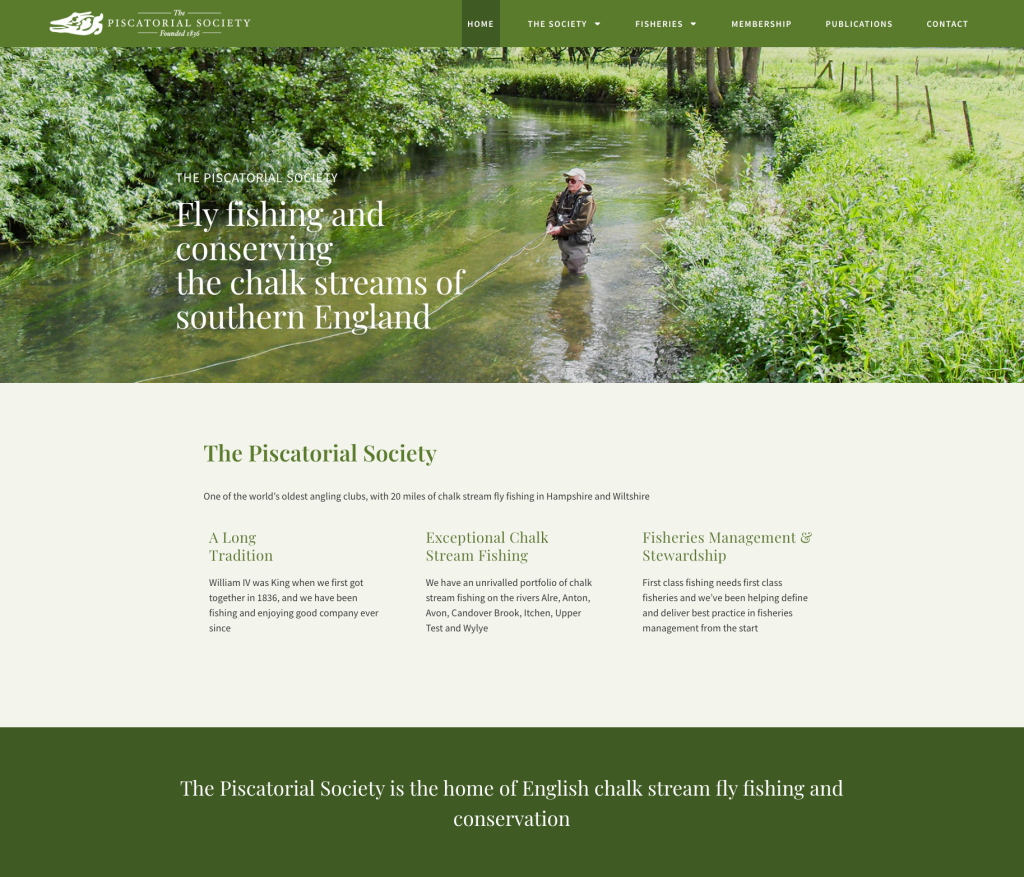
The Piscatorial Society wanted to replace its ageing public website. The aim was to move away from what had become an online brochure and create a website that would help attract new members and fishery owners. They asked Abricot to design and build its replacement.
Project Details
Client
The Piscatorial Society
Sector
Membership organisation & conservation
Audience
Prospective members, fishery owners, conservation organisations and potential partners
Working with
Communications Lead,
committee members and subject specialists
Work included
Website strategy | Information architecture | Content restructuring | Web design & development | Prospective member journey | Intranet migration | Hosting, maintenance & ongoing support
Identifying the Website's Objectives
Make information easier to find and understand.
The Key Challenge
Designing one website around different priorities
Starting with what each visitor needed
The old website largely presented the Society as it understood itself. The new structure began instead with the questions different visitors would bring to it.
Prospective members needed more than information about joining. They needed to understand what membership would give them: the fisheries, the fishing, the social side of the Society and the experience of belonging to it. Fishery owners needed a different view—one that demonstrated responsible fisheries management, conservation work and the value of forming a long-term relationship with the Society.
Giving each audience its own route
These audiences did not need separate websites, but they could not all be expected to follow the same journey. The navigation and page structure created different routes through the same organisation, allowing visitors to move towards the information most relevant to them while still discovering the wider Society.
This meant treating membership, fisheries, fisheries management, conservation, Society life and partnerships as connected parts of one story—not unrelated subjects competing for attention.
Using history to support the Society’s present
The website
Rather than organising the website around the Society’s internal structure, the content was arranged around what each visitor needed to understand. Prospective members could explore the fisheries, Society life and the experience of membership, while fishery owners could see the Society’s approach to fisheries management, conservation and long-term partnerships.
The navigation brought these different aspects of the Society together without forcing every visitor through the same journey. Its history, publications and conservation work added depth and credibility throughout the website, while the route towards membership remained clear.
This allowed the Society to speak to audiences with very different priorities through one coherent website—without reducing it to a simple fishing club or separating its work into disconnected parts.
Early results
14.36 → 6.47
Average Google position
+63%
Search click-through rate
9 enquiries
The Society’s highest August total on record
Committee Feedback
I wanted to rebuild the site because the current one is more of an online corporate brochure and what we need is something that focuses on recruiting new members (and waterlords). You've made that happen.
If I were a prospective member, I would certainly be encouraged to find out more and make contact. Equally, if I were a fishery owner considering which clubs to work with, I think the website would give me real confidence that the Society is one I would want to speak to about renting my water.
Great stuff. Easy to navigate and read, short, sharp and to the point. Wonderful visuals. Nice balance between fishing and social.
I particularly like the navigation through the website which is crisp and straightforward.
What This Project Reinforced
More traffic isn’t necessarily better traffic. Since the new site launched, it has appeared in fewer Google searches than the old one, but its average position and click-through rate have improved significantly — and membership enquiries have increased.
What matters isn’t simply how many people see or visit a website, but whether it is reaching the right people and helping them do what they came there to do.